The Weight of a Brick: Pundalik's Legend and the Meaning of Divine Waiting
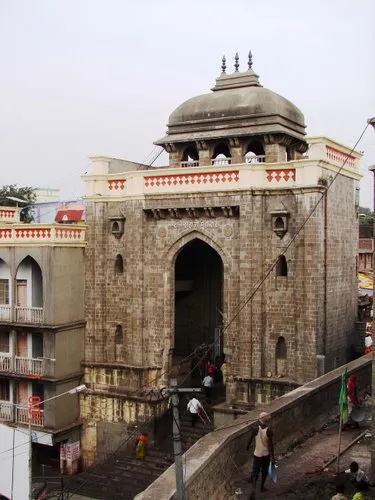
Photo: Anjali Sajan, CC BY-SA 3.0, via Wikimedia Commons
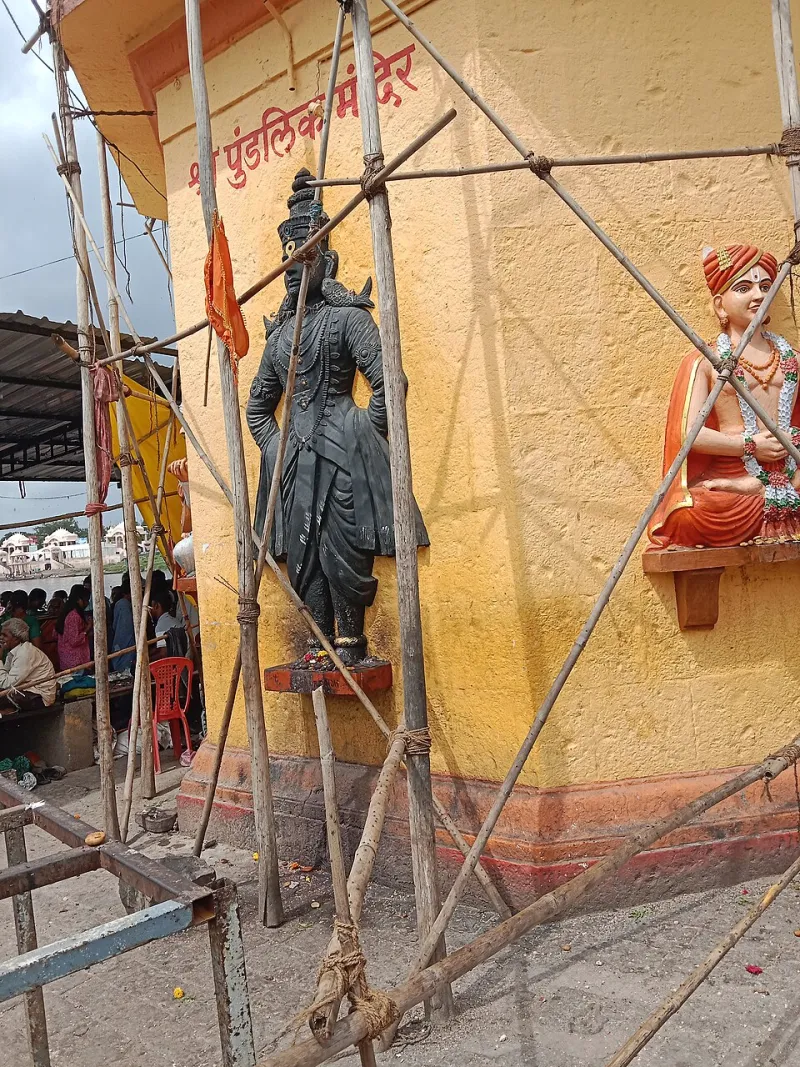
In Pandharpur, the Lord stands on a brick. This is one of the most familiar images in Marathi devotional life, and also one of the most quietly strange. Vitthal does not sit on a jeweled throne. He does not recline on a serpent couch. He stands with hands resting at his waist, waiting. Beneath his feet is a simple brick, the kind a householder might use for a stove or a wall. The legend behind that posture is the story of Pundalik, and it carries layers of meaning that are easy to flatten into a moral and harder to receive as a living teaching.
The story as Maharashtra tells it
The best-known account begins with Pundalik as a young man who neglected his parents. He traveled to Kashi with his wife, preoccupied with his own concerns, and treated his mother and father with indifference. At the ashram of a sage, he is said to have witnessed a night gathering of holy figures and been shaken by what he saw. The experience turned him inward. He returned home, asked forgiveness, and devoted himself to serving his parents with steadiness and humility.
In time, the Lord came to see him. The tradition names the visitor as Krishna, who is worshipped in Pandharpur as Vitthal. Pundalik was in the middle of serving his parents. He did not abandon the task to greet the divine. Instead, he offered the Lord a brick to stand upon and asked him to wait. Vitthal accepted. He has been standing on that brick ever since.
There are variations in the telling, as there are with most living legends. Some emphasize Pundalik's earlier failure; others focus on the moment of his reform. Some dwell on the Lord's eagerness to meet the devotee; others on the devotee's composure. The differences do not weaken the story. They show that the community has returned to it again and again, finding in it a mirror for different seasons of life.
A brick from the household, not a throne
The first thing to notice is the object itself. A brick is ordinary, heavy, and useful. It belongs to construction, to hearths, to the plain work of living. When Pundalik offers it, he is not offering gold or silk. He is offering what is at hand. The Lord accepts it.
This is not a lesson in shabbiness. It is a statement about the nature of divine presence. The sacred is not confined to polished places. It can rest on what is humble, provided the offering is made with attention. In American homes, where many families cannot replicate the architecture of a temple, this detail matters. A small shelf, a simple lamp, a clean cloth, and a quiet corner can hold the same truth. The brick does not become sacred because of its material. It becomes sacred because the Lord stands on it and because a devotee offered it.
Service before spectacle
Pundalik's choice is often summarized as service to parents coming before greeting God. That is true, but it is not a simple rule that can be applied mechanically. The story is not saying that family obligations always outrank worship, or that the divine is indifferent to devotion. It is showing a hierarchy of attention in which the concrete duty in front of the devotee is not abandoned for a more dramatic spiritual experience.
Pundalik was serving his parents when the Lord arrived. To leave them mid-task would have been to treat devotion as performance. The story suggests that the test of love is not only in the temple but in the kitchen, the caregiving room, the hospital corridor, and the ordinary work of maintaining a household. For American readers, this may raise difficult questions about elder care, work schedules, and the claims of family. The legend does not answer those questions neatly. It simply places them inside the field of devotion rather than outside it.
The devotee's strange authority
There is another layer that is easy to miss. Pundalik asks the Lord to wait. This is not presented as arrogance. It is presented as intimacy. The devotee has the freedom to speak to the divine as one speaks to a guest in the home. The Lord, in turn, accepts the request. Vitthal stands.
The posture is therefore not only about Pundalik's priorities. It is about the vulnerability of the divine in relation to the devotee. Bhakti is not a transaction in which the worshipper appeases a distant power. It is a relationship in which the Lord can be asked to wait, and can choose to wait. This is a theological claim, not a productivity tip. It does not mean that every delay is sacred or that every obligation is a divine appointment. It means that devotion creates a form of nearness in which ordinary human gestures can carry extraordinary weight.
Patience that is not passivity
Vitthal's waiting is sometimes described as patience, but the word can be misleading. The standing Lord is not passive. He is attentive. His posture holds expectation and presence at once. The brick beneath his feet is a reminder that waiting can be an active form of love.
In modern American life, waiting is often treated as waste. We apologize for it, optimize it, and fill it with screens. The Pundalik story does not romanticize delay, but it does suggest that some forms of waiting are worth choosing. Waiting for a parent to finish speaking. Waiting for a child to calm down. Waiting for a guest to arrive. Waiting before speaking a harsh word. These are not spiritual achievements to be advertised. They are small acts of fidelity, and the legend places them near the heart of devotion.
Why the posture still matters
The image of Vitthal standing on a brick has traveled far beyond Pandharpur. It appears on calendars, in songs, and in the minds of pilgrims who cannot make the journey. Its power lies in its refusal to separate the sacred from the ordinary. The Lord stands on a household object because a householder asked him to. The devotee serves his parents because that is the work in front of him. The divine waits because love makes waiting possible.
To meditate on this story is not to extract a slogan from it. It is to let its layers remain. Pundalik is a flawed son who becomes a devoted one. The Lord is eager to meet him and willing to wait. The brick is common and becomes the floor of a lasting shrine. In that tangle of failure, service, patience, and intimacy, the legend continues to teach.