Temples Across the Continent: Tracing the Sacred Footprint of Vitthal-Rukmini in North America
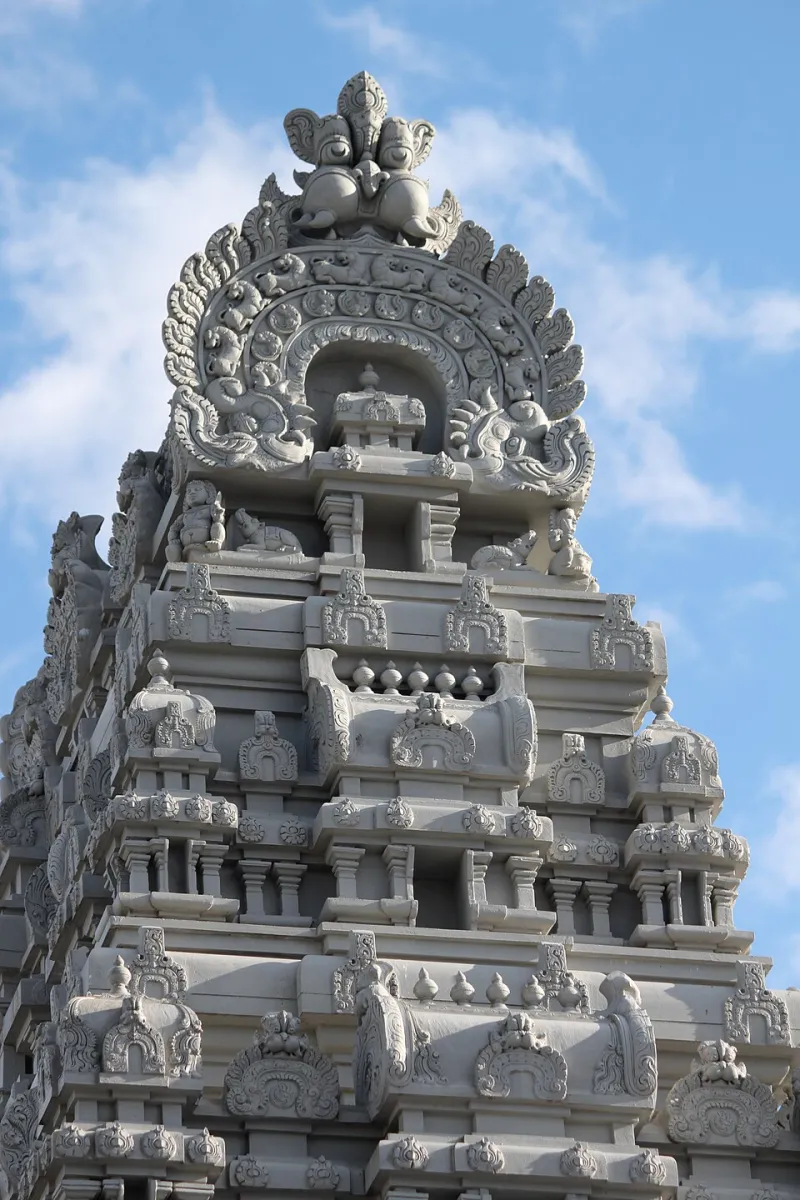
Photo: Benniken, CC BY-SA 4.0, via Wikimedia Commons
There is a photograph, taken sometime in the late 1970s, that circulates among a small community of Maharashtrian families in the Chicago suburbs. In it, a small group of men and women — dressed in their finest, clearly aware of the historical weight of the moment — stand before a modest altar in someone's living room. At the center of the altar, flanked by marigolds and a single brass lamp, is a small framed image of Lord Vitthal and Goddess Rukmini.
It was not a grand occasion by any external measure. There was no marble, no bell tower, no processional. But for the families gathered in that suburban living room, it was the beginning of something that would eventually grow into a network of temples, cultural organizations, and community anchors stretching across the North American continent.
Today, that network is more extensive — and more significant — than most Americans, including many within the South Asian diaspora, realize.
The First Wave: Devotion in the Living Room
The story of Vitthal-Rukmini temples in America begins not with architecture, but with migration. The Immigration and Nationality Act of 1965 opened the United States to a new wave of immigrants from South Asia, and among those who arrived in the late 1960s and 1970s were thousands of families from Maharashtra — engineers, doctors, academics, and entrepreneurs who brought with them not only professional ambition but deep devotional traditions.
For these early arrivals, maintaining a connection to Vitthal bhakti was both a spiritual necessity and a cultural lifeline. In the absence of formal temples, homes became sacred spaces. Basements were converted into puja rooms. Living rooms hosted the Ashadhi and Kartiki Ekadashi celebrations — the two great festival days of the Warkari calendar — with the same seriousness and joy they had known in Pune, Nashik, or Aurangabad.
"My grandmother used to say that Vitthal was the one who came with us on the plane," recalls Sunita Joglekar, a second-generation Maharashtrian-American and community historian based in New Jersey. "She didn't mean it literally, of course. She meant that the connection to Vitthal was portable in a way that other aspects of home life were not. You didn't need a specific place. You just needed your devotion."
From Informal Gatherings to Formal Temples
As Maharashtrian communities grew in size and economic stability through the 1980s and 1990s, the informal home-based worship of Vitthal-Rukmini began to formalize. Community associations — often organized under names referencing the Warkari tradition or the Pandharpur pilgrimage — began raising funds for dedicated worship spaces.
The process was rarely simple. Acquiring land, navigating local zoning regulations, fundraising across a geographically dispersed diaspora, and managing the considerable logistical challenge of installing traditional Hindu temple consecrations (pratishtha ceremonies) in American contexts required extraordinary community effort.
Some communities partnered with larger, pan-Hindu temple organizations, establishing Vitthal-Rukmini shrines within broader South Asian religious centers. Others pursued independent facilities. A few remarkable communities managed to construct purpose-built temples with traditional Hemadpanthi or Nagara architectural elements — a feat requiring not only financial resources but the importation of skilled craftspeople (shilpis) from India.
Temple Spotlights: A Continent of Sacred Spaces
The New Jersey Corridor
New Jersey has long been home to one of the largest and most organizationally sophisticated Maharashtrian communities in the United States. The corridor stretching from Edison to Parsippany hosts multiple organizations devoted to Vitthal-Rukmini worship, with the most established communities conducting full Ashadhi Ekadashi celebrations that draw attendees from across the northeastern United States.
The Vitthal-Rukmini Mandir in Edison, which began as a community-organized puja group in the early 1990s, now occupies a dedicated facility and conducts daily abhishek (ritual bathing of the deity) following traditional Pandharpur protocols. The presiding priest, trained in Maharashtra, maintains the precise liturgical standards of the Pandharpur tradition — a detail of profound importance to community members for whom authenticity of practice is inseparable from spiritual efficacy.
The Chicago Metropolitan Area
Chicago's Maharashtrian community is among the oldest and most historically rooted in the United States, and its relationship with Vitthal-Rukmini worship reflects that longevity. Community organizations in the western suburbs — particularly in areas like Naperville, Schaumburg, and Lisle — have maintained continuous Vitthal bhakti programming since the 1980s.
The annual Dindi procession — a miniature recreation of the Warkari pilgrimage tradition in which devotees carry the padukas (symbolic footwear) of saints in a ceremonial march — has been held in the Chicago area for over two decades. It is, by any measure, a remarkable sight: hundreds of devotees in traditional Warkari white, singing abhangas, moving through American suburban streets with the same devotional energy that animates the great pilgrimage roads of Maharashtra.
The Bay Area and Pacific Coast
The San Francisco Bay Area's large and professionally prominent Indian-American community supports several organizations with strong Vitthal-Rukmini worship traditions. Temple communities in Fremont, Milpitas, and San Jose have established regular kirtan programs and festival observances that draw participants from across Northern California.
In the Pacific Northwest, smaller but deeply committed communities in Seattle and Portland have established Vitthal bhakti circles that blend traditional practice with the region's characteristic openness to contemplative spirituality — drawing, in some cases, non-Indian practitioners who discovered Vitthal worship through yoga communities or world music events.
Texas and the Southern States
Houston and Dallas, home to substantial South Asian populations, both support Vitthal-Rukmini worship within the context of larger Maharashtrian cultural associations. The Houston community has been particularly active in youth programming, conducting Vitthal bhakti education for second and third-generation members who may have limited direct connection to the Pandharpur tradition.
Why These Temples Matter Beyond the Community
It would be easy to frame the story of Vitthal-Rukmini temples in America as a story about one community maintaining its traditions in a foreign land. That framing, while not inaccurate, is importantly incomplete.
These temples are becoming something broader: genuine bridges between Hindu spiritual tradition and American civic and cultural life. Many of them host interfaith events, cultural education programs open to the general public, and wellness programming — including yoga, meditation, and kirtan — that serves participants from diverse backgrounds.
In this sense, they are performing a function that the great mandirs of India have always performed: serving as centers of community life, cultural transmission, and spiritual education that extend well beyond the boundaries of any single religious affiliation.
"This temple is not just for Maharashtrians," explains the president of one New Jersey Vitthal-Rukmini organization, who asked not to be named. "It is for anyone who wants to experience the presence of the divine through this tradition. Vitthal belongs to everyone who comes to him. That is the fundamental teaching of the Warkari saints."
Preserving the Mythology, Adapting the Practice
One of the most delicate challenges facing these communities is the negotiation between preservation and adaptation. The Pandharpur tradition is extraordinarily specific in its liturgical requirements, its festival calendar, and its theological emphases. Maintaining that specificity in an American context — where second-generation members may speak limited Marathi, where the agricultural rhythms that shaped the Warkari festival calendar have no local parallel, and where the demands of American professional life press relentlessly against the time available for extended devotional practice — requires ongoing, thoughtful effort.
Many communities have responded with creativity. Abridged festival observances that honor the full liturgical intent without requiring multi-day participation. Bilingual programming that presents Marathi abhangas with English explanations. Digital archives of devotional music and mythology that allow diaspora members to maintain connection regardless of geographic proximity to a temple.
At Shree Vitthal Rukmini, we see in this creative adaptation not a dilution of tradition, but its truest expression. The Warkari saints themselves were innovators — they brought the sacred out of the temple and into the street, out of Sanskrit and into the vernacular, out of the exclusive preserve of the learned and into the hands of every farmer, weaver, and laborer who longed for the divine.
The Vitthal-Rukmini temples of North America are doing something genuinely continuous with that ancient spirit: finding new ways to make the eternal accessible, one community at a time.
Finding Your Nearest Vitthal-Rukmini Community
For readers in the United States seeking to connect with a local Vitthal-Rukmini worship community, we recommend beginning with regional Maharashtrian Mandals and the Vishwa Hindu Parishad of America, both of which maintain directories of affiliated organizations. Major metropolitan areas with large South Asian populations — New York, New Jersey, Chicago, Houston, Dallas, Atlanta, the Bay Area, and Los Angeles — are the most likely to have active communities.
If no formal temple exists in your area, remember the spirit of those early families in their Chicago living room: devotion does not require a building. It requires only an open heart and the willingness to begin.
Vitthal is waiting.