Seven Lessons from the Divine Beloved: How Madhura Bhava Can Deepen Your Most Intimate Relationships
In American culture, we tend to keep two categories firmly separated: the spiritual and the romantic. Religion belongs in one corner; love lives in another. The result is that we often navigate our most important human relationships without the wisdom our deepest traditions have to offer — and we approach our spiritual lives without the emotional intelligence that intimate love cultivates.
The Vitthal-Rukmini tradition, rooted in the devotional soil of Maharashtra and now flowering in temples and living rooms across North America, has never accepted this separation. At its center is madhura bhava — literally, the "sweet mood" — the devotional practice of relating to the Divine as one's most intimate beloved. It is not metaphor. It is a complete relational theology, and its insights apply with striking directness to the human partnerships we are all, in our own ways, trying to build.
Here are seven of its most enduring lessons.
1. Desire Is Not the Enemy of the Sacred
In many Western religious frameworks, desire — especially erotic or romantic desire — is treated with suspicion, as a force requiring suppression or at minimum careful management. Madhura bhava takes the opposite view. The longing of the devotee for the Divine is not merely tolerated in this tradition; it is celebrated as one of the most authentic expressions of the soul's nature.
Rukmini's letter to Vitthal is saturated with desire. She does not apologize for it. The Bhagavata Purana does not ask us to read it allegorically, as if the real meaning were something more respectable than what it says on the surface. The desire is the point.
For your partnership: Bring this same unapologetic quality to your appreciation of your partner. The tradition suggests that longing, when directed honestly, is a form of reverence. Tell your partner what you find beautiful about them. Do not domesticate your affection into mere familiarity.
2. Full Disclosure Is an Act of Trust
In madhura bhava practice, the devotee holds nothing back from the Divine. The classical texts of this tradition — the abhangas of the Warkari saints, the poetry of Mirabai, the love hymns of Andal — are remarkable for their emotional nakedness. Saints write of jealousy, of grief, of the specific texture of longing at two in the morning. Nothing is edited for propriety.
This radical transparency is understood not as spiritual immaturity but as its opposite: the willingness to be fully known is the highest form of trust.
For your partnership: Psychological research on relationship satisfaction consistently identifies vulnerability as a primary driver of intimacy. The madhura bhava framework offers this same insight in devotional language: to be fully seen by the beloved — and to choose to be seen — is itself a sacred act.
3. Celebration Is a Spiritual Discipline
The Vitthal-Rukmini tradition is not a somber one. Its festivals are exuberant. Its music is joyful. The relationship between Vitthal and Rukmini is characterized in the devotional literature not only by depth and devotion but by playfulness, beauty, and delight. The Divine is not merely to be worshipped; the Divine is to be enjoyed.
This principle — that celebration is itself a form of devotion — runs counter to certain strains of ascetic spirituality that treat pleasure with suspicion.
For your partnership: Make celebration a regular practice, not an occasional event. Mark anniversaries with genuine intention. Find reasons to acknowledge your partner's qualities in ordinary moments. The tradition suggests that gratitude expressed aloud is a form of worship — and it transforms both the one who offers it and the one who receives it.
4. The Beloved Deserves Your Best Attention
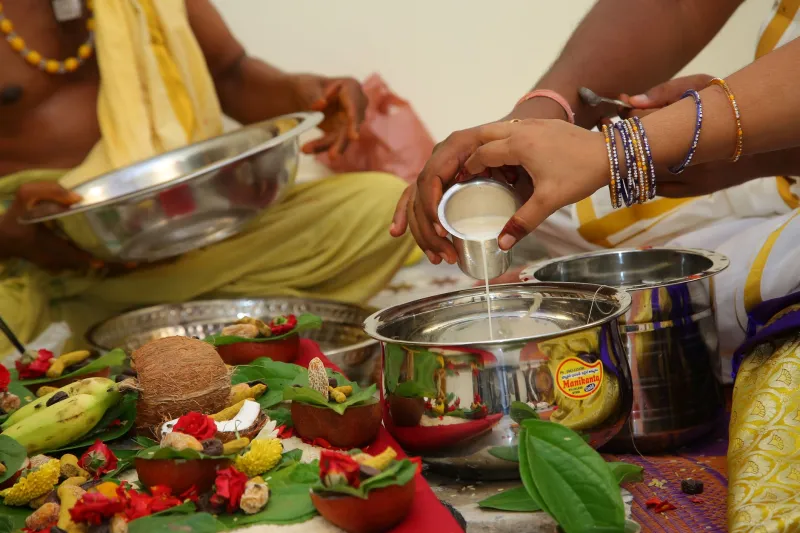
In the formal practice of puja — the daily ritual worship of the Divine — the devotee offers the Lord the finest things available: fresh flowers, pure water, carefully prepared food, fragrant incense. The underlying principle is that the beloved is worthy of one's most careful, considered attention. Half-heartedness is not devotion.
For your partnership: Consider how often intimate relationships become the space where we offer our residual energy — what is left after work, social obligations, and personal maintenance have taken their share. The madhura bhava framework inverts this hierarchy. The beloved receives your first and finest attention, not your last.
5. Separation Deepens the Relationship
One of the most theologically rich dimensions of madhura bhava is its treatment of viraha — the pain of separation from the beloved. Rather than treating this pain as a problem to be solved, the tradition understands it as a form of devotion in its own right. The ache of longing is itself a mode of connection; it keeps the beloved present in the devotee's consciousness even in their absence.
The great bhakti poets wrote some of their most luminous verses in the register of viraha. Absence, in this framework, is not the opposite of relationship. It is one of its seasons.
For your partnership: In long-term relationships, the challenge is often not separation but over-familiarity — the erosion of the quality of attention that characterized the relationship's early stages. Viraha, understood as a practice, suggests cultivating the capacity to miss your partner even while they are present: to remember who they are to you, to resist the numbing effect of routine.
6. The Relationship Has a Cosmological Dimension
In Vitthal-Rukmini devotion, the union of the Lord and his consort is not merely a personal story. It is a cosmic event: the coming together of two principles whose relationship sustains the order of the universe. The devotee who enters into madhura bhava participates in this cosmic drama. Their love is not merely personal; it is, in some sense, a reflection of the divine pattern.
This is a remarkable reframing of what intimate love means. It is not a private transaction between two individuals. It is a participation in something larger.
For your partnership: Understanding your relationship as having a dimension beyond the personal — as contributing something to your family, your community, your spiritual tradition — can provide a source of meaning that purely individualistic frameworks cannot. Your partnership is not just about you. It is, in its own modest way, a sacred thing.
7. Devotion Requires Renewal
Even the most ardent devotee must return daily to the practice of worship. The tradition does not assume that a single transformative experience is sufficient to sustain a living relationship with the Divine. Puja is performed every morning. Prayers are offered every evening. The relationship requires continuous, intentional tending.
For your partnership: The research on relationship longevity strongly supports what the devotional tradition has always known: love is not a state that, once achieved, maintains itself automatically. It is a practice. It requires daily renewal through attention, kindness, and deliberate choice.
Madhura bhava, at its core, is an argument that love — when approached with full seriousness, full presence, and full spiritual intention — is one of the most reliable paths to the Divine. The Vitthal-Rukmini tradition does not ask you to choose between loving God and loving the people in your life. It suggests, with great gentleness and considerable sophistication, that in learning to love well in one domain, you inevitably deepen your capacity in the other.